
Most people choose a face mask with their eyes. The packaging, the swatch, the video where it peels off in 1 satisfying sheet.
Which is understandable, and also why so many masks end up half-used in a drawer. A mask that looks amazing in someone else's routine can do nothing in yours, because the only 3 things that decide whether a mask works for you are your skin type, the mask's format, and what is actually in it.
Get those 3 right, in that order, and choosing becomes easy. Here is the whole logic in 1 read.
Step 1: know what your skin actually needs
Skip the quiz. Answer 2 questions instead.
Question 1: by 2pm, is your face shiny?
Yes means you produce a lot of oil. No means you run normal to dry.
Question 2: after cleansing, does your skin feel tight?
Yes means your skin is short on water. No means your hydration is fine.
That gives you 4 combinations, and in Malaysia the most common one surprises people: shiny and tight. Oily and dehydrated at the same time, courtesy of a hot climate outside and 8 hours of air conditioning inside. Oil is not water, and skin that is losing water often makes more oil to compensate. We broke down that cycle in dehydrated skin vs oily skin.
One more check before you shop: if most products sting lately and your face turns red easily, sort that out first. That is a stressed barrier, not a skin type, and we covered the repair plan in how to repair a damaged skin barrier.
Step 2: understand what each texture actually does
Texture is not packaging. It is the mechanism. Each format physically does 1 main job, and no amount of marketing changes what the format can deliver.
Sheet masks are a cut fabric soaked in essence. They push hydration for the 15 to 20 minutes they are on, then the job ends, and leaving them longer works against you. Convenient, single-use, and the fit never quite matches your face. We compared them properly in sheet mask vs jelly mask.
Clay and mud masks work like a sponge for oil. They soak up sebum and dry down hard. Effective for a genuinely oily T-zone, and drying for everything else, which is why the tight, squeaky after-feel is not a bonus. The full comparison is in clay mask vs jelly mask.
Peel-off masks grip the surface and come off in a sheet, taking fine hairs and the top layer of dead cells with them. Satisfying to watch, harsh in practice, and the format most likely to leave skin red. If your skin leans sensitive, this is the first format to drop.
Wash-off jelly masks are a thick layer of water-based gel that sits on the skin, usually 15 minutes, then rinses off with water. The jelly holds water against your face the entire time, so the format's core job is hydration without any friction: nothing to pull, nothing to dry hard, nothing to peel. A deep cleansing version flips the job: the gel softens and lifts the gunk sitting in pores, then leaves with the rinse. The honest trade-off of the whole format: it needs a sink and 15 unhurried minutes, so it is a home ritual, not a handbag product.
Sleeping masks are leave-on moisturisers in disguise. Fine as a final step, but they seal in whatever is underneath, so they reward an already good routine rather than fixing a bad one.
Step 3: read the ingredients, not the front label
The front of the jar tells you the mood. The ingredient list tells you the job. You only need to recognise a shortlist.
If your skin needs water, look for: glycerin, hyaluronic acid (sometimes listed as sodium hyaluronate), panthenol, aloe, rose extract. These are humectants and soothers. They pull water into the skin and calm it down.
If your skin needs a clean-out, look for: salicylic acid (oil-soluble, gets into pores), glycolic acid (surface renewal), kaolin or charcoal (oil absorption). These do real work, which also means they carry a frequency limit.
If your skin is sensitive, shortlist masks with a short ingredient list, and be cautious with: denatured alcohol high on the list, added fragrance, menthol or peppermint. That cooling, tingling feeling is often just irritation wearing a nice costume. Tingling is not "it is working".
Whatever your skin type, a rinse-off format buys you safety margin: whatever you are unsure about is on your face for 15 minutes, not 8 hours.
The decision table
Find your row, and you are done.
| Your skin | Format that fits | Ingredients to look for | Frequency ceiling |
|---|---|---|---|
| Oily and dehydrated (the Malaysian combo) | Hydrating wash-off jelly as the base, deep cleansing mask on the T-zone | Glycerin, hyaluronic acid, rose extract; glycolic acid or charcoal for the T-zone | Hydrating daily, deep cleansing 2 to 3 times a week |
| Genuinely oily, no tightness | Deep cleansing jelly or clay | Salicylic acid, glycolic acid, kaolin, charcoal | 2 to 3 times a week |
| Dry or tight all over | Hydrating wash-off jelly, sheet mask as a top-up | Glycerin, hyaluronic acid, panthenol, aloe | Daily |
| Sensitive or reactive | Rinse-off hydrating jelly, short ingredient list | Aloe, panthenol, rose extract; avoid fragrance-heavy and peel-off formats | Daily once your skin says yes; patch test anything new first |
| Breakout-prone | Deep cleansing mask on affected zones only | Salicylic acid, charcoal; avoid heavy occlusive layers | 2 to 3 times a week, zones only |
You are allowed to use 2
The single biggest unlock in mask shopping: your whole face does not have the same skin.
An oily T-zone and dehydrated cheeks are 2 different jobs, and 1 mask cannot do both at once. The fix is multi-masking: a deep cleansing mask on the T-zone where the oil lives, a hydrating mask on the cheeks where the tightness lives, same 15 minutes, rinse everything together.
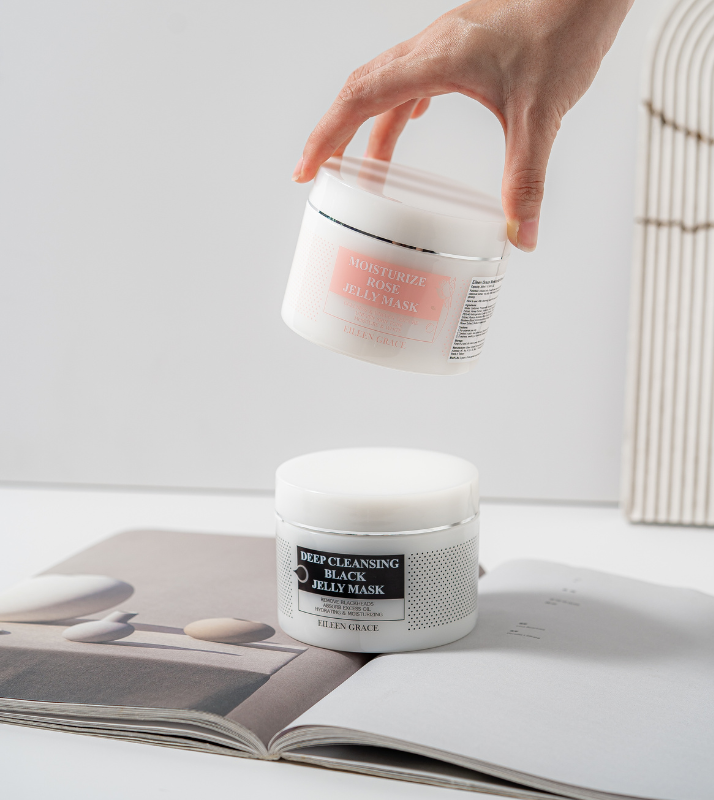
That is exactly how our 2 jelly masks are designed to pair. The Eileen Grace Deep Cleansing Black Jelly Mask takes the T-zone: glycolic acid softens and lifts what is sitting in the pores, and it rinses off instead of drying hard. The Eileen Grace Moisturize Rose Jelly Mask takes the cheeks: a thick, chilled layer of rose jelly that floods the skin with water for 15 minutes. One clears, one quenches, and each stays in its own zone doing its own job.
Scoop each on generously. A jelly mask only works as a proper thick layer, thick enough that you cannot see your skin through it. A thin, see-through smear dries out before the 15 minutes are up and delivers almost nothing.
If you want to test the fit before committing to full jars, the 35ml trial pack exists for exactly this.
5 shopping red flags
- "Fixes everything at once" as the main claim. Suiting all skin types is fine, plenty of well-formulated masks do. The pause-worthy claim is a mask that promises every result in 1 jar: hydrates, controls oil, clears breakouts, brightens, firms. A formula pulled in 5 directions usually delivers none of them properly. Pick a mask that names its 1 job.
- The sensation is presented as the proof. The tingle means it is working, the peel shows you the results, the colour change means it pulled something out. None of those are evidence: a tingle is often irritation, and the drama is designed for the camera. A mask is allowed to feel wonderful (we will defend a chilled mask on a hot afternoon to the end), but the feeling should sit on top of a real mechanism, not stand in for one.
- No ingredient list visible before you buy. The list is the product.
- A deep cleansing mask recommended daily. Real actives need rest days. If it can be used daily, question what it is actually doing. The frequency logic is in how often you should use a face mask.
- Your face breaks out every time you use it. That is not "purging" for a hydrating mask. We unpacked when a mask is the culprit in is your face mask causing breakouts.
Frequently asked questions
How do I choose a face mask for my skin type?
Answer 2 questions: is your face shiny by afternoon, and does it feel tight after cleansing? Shiny means you need oil control, tight means you need water, both at once means you multi-mask: deep cleansing on the T-zone, hydrating on the cheeks.
Which face mask is best for oily skin in Malaysia?
Oily skin here is very often dehydrated underneath. Use a deep cleansing mask with glycolic acid or charcoal on the oily zones 2 to 3 times a week, and a hydrating mask to put water back, so your skin has a reason to stop overproducing oil.
What ingredients should I look for in a hydrating mask?
Glycerin, hyaluronic acid, panthenol, aloe and rose extract. They draw water into the skin and soothe it.
Are peel-off masks bad for your skin?
They are the harshest common format. The satisfying peel takes fine hairs and surface cells with it, and sensitive skin usually shows it. A rinse-off mask delivers the finish without the pull.
Can I use 2 different masks at the same time?
Yes, on different zones. Deep cleansing on the T-zone, hydrating on the cheeks, same session, rinse together. What you should not do is stack 2 masks on the same spot back to back.
How thick should I apply a jelly mask?
Thick enough that you cannot see your skin through it. The layer is the delivery system: too thin and it dries out before it finishes the job.
The bottom line
Ignore the feed. Read your own face: shiny or not, tight or not. Pick the format that matches the job, check the shortlist of ingredients, respect the frequency ceiling.
And if your face is 2 skin types at once, like most faces in this climate, stop looking for 1 perfect mask. Use 2, each where it belongs.
15 minutes, rinse, done. Your drawer of half-used masks can finally retire.