
Most skincare advice starts by asking you to pick a lane. Oily or dry. Then it hands you a routine built for whichever one you chose.
That question has no answer if your nose is shiny by lunchtime and your cheeks are flaking by the time you take your makeup off. If you are unsure where to start, our how to choose a face mask for your skin type guide breaks it down first.
So you try to solve it the sensible way, one product at a time. You reach for something rich enough to stop the flaking, and within 2 days your T-zone is worse than it started. You switch to something that keeps the shine down, and now the flaking has spread. Fix one half, break the other. Fix that half, break the first one again.
At some point most people stop looking. That is a completely reasonable response to a problem that has been quietly rigged.
Combination skin is not a milder version of anything
The word makes it sound like a middle setting. Somewhere between oily and dry, so presumably something in between should work.
It is the opposite. Combination skin means 2 different conditions, on the same face, at the same time, each needing something the other one cannot tolerate. Your T-zone has active oil glands and congested pores. Your cheeks are short on water and losing it faster than they can hold it. Those are not degrees of the same problem. They are 2 problems that happen to share a face.
Which is why a single product cannot win. Whatever you spread over the whole face is correct for one half of it and wrong for the other half. That is not bad luck with brands. It is arithmetic.
The complaint we hear most often sounds something like this: I have been trying to figure this out for years, and I still cannot find anything that speaks to my exact situation. That is not a research failure. Most advice is written for people whose whole face agrees with itself.
In Malaysia it is not a phase, it is a daily cycle
Elsewhere people describe this as something that changes over months. Here it changes over hours.
You step outside and the humidity and heat push oil production up. You get into the car, then into an air-conditioned office, and for the next 8 hours the air is actively pulling water out of your skin. By 4pm your cheeks feel tight and your nose is still shiny. You step out again in the evening and the oil comes straight back.
That is 2 opposite environments in 1 day, every day, all year. Your skin does not get a settling period, which is why the pattern feels more extreme here than what you read online. We went deeper into the office half of that cycle in the aircon routine guide.
Before you go further, rule out one thing
There is a version of this that looks identical but needs the opposite treatment: skin that is oily because it is dehydrated. Water loss, not skin type. When skin keeps losing water, it often produces more oil to compensate, so you end up shiny and tight at the same time, all over, not zone by zone.
The quick tell is where it happens. True combination skin is a map: shiny in the middle, tight at the edges. Dehydrated skin is everywhere at once. We laid out the full difference in dehydrated skin vs oily skin.
One more check. If most products have started to sting lately and your face flushes easily, deal with that first. That is a stressed barrier, not a skin type, and the barrier repair plan comes before any of this.
Stop treating your face as one surface
Once you accept that you have 2 conditions, the solution stops being a search and becomes a layout.
You treat the T-zone for what the T-zone actually has, and you treat the cheeks for what the cheeks actually have, in the same session. The technique has a name, multi-masking, and it has been around for years. Most people who hear about it never do it twice.
The reason is not the concept. The reason is that it is usually a logistics problem. Different masks have different timings, so by the time you have finished applying the last one, the first one is drying out and needs to come off. You end up standing at the sink managing a schedule.
There is also a quieter version of the same problem: people deliberately rinse the mask off their dry areas early, before the full time is up, because they are afraid of making those areas worse. Which means they are masking defensively, and not getting the full benefit anywhere.
So the format matters as much as the mapping.
The zone map
2 questions decide everything.
Where does your skin get shiny and congested? For most people that is the forehead, the nose and the chin. This zone wants a deep cleansing mask that softens and lifts what is sitting in the pores.
Where does your skin get tight, flaky or rough? Usually the cheeks, sometimes along the jaw. This zone wants hydration held against the skin, with no scrubbing and nothing that dries down hard.

Clay is the format most people reach for on the T-zone, and it works there. The problem is that clay dries down hard and does not stay politely inside the lines, so the edges of it end up sitting on cheeks that did not need it. We compared the 2 formats properly in clay mask vs jelly mask.
A wash-off jelly avoids that, because it stays a soft gel the entire time and leaves with water rather than being pulled off.
How to actually do it
This is the part that decides whether it works.
- Scoop both jars first. Get them open before you start, so nothing is waiting on your face while you fight with a lid.
- Deep cleansing jelly on the T-zone. Forehead, nose, chin.
- Hydrating jelly on the cheeks. Both sides, out towards the jaw if that area feels tight too.
- Go thick. A thin smear of either one dries out on your face, and that tight, uncomfortable feeling people blame on the mask is usually just a layer that was too thin to last.
- Wait 15 minutes. Both zones, same 15 minutes.
- Rinse everything off with warm water, until the slippery feeling is gone. Pat dry with a towel.

What makes this work is not that it is quick. It is that neither half of your face has to lose. The T-zone is being treated for congestion by something meant for congestion, and the cheeks are being hydrated by something meant for hydration, and neither one is being handed a compromise that was designed for the other.
That is the whole difference. One product across the whole face is right for half of it by definition. 2 of them, placed where they belong, are right for all of it.
The practical side is easier than people expect, because both jellies sit for the same 15 minutes and both leave with water. Nothing needs staggering, and you are not cutting the dry side short to protect it, because what is sitting there is a hydrating layer that has no reason to come off early.
Frequency, and why the 2 zones are different
This is where people usually get it wrong in the other direction.
A hydrating wash-off jelly is gentle enough to use daily. There is nothing in it that needs a recovery period.
A deep cleansing mask is not, because the ingredients that clear out pores also have a limit. 2 to 3 times a week is plenty for the T-zone. Doing it nightly does not clear your pores faster, it just thins out your barrier until everything starts stinging.
So a realistic week looks like hydration most nights, with the T-zone getting its deep clean on 2 or 3 of them. Our full frequency guide covers the other formats.
What to expect, honestly
The first thing most people notice is not dramatic. It is that after rinsing, the nose does not feel greasy and the cheeks do not feel tight, in the same session. That specific combination is the thing that has been out of reach.
2 other things worth saying plainly. If you have been using a drying mask over your whole face for a while, your cheeks may take a couple of weeks to stop flaking, because you are undoing something. And if you are new to deep cleansing on the T-zone, congestion that was already sitting under the surface can come up in the first week or so before it settles.
Neither means it is going wrong.
Your face was never one thing
The reason nothing worked is not that you had not found the right product yet. It is that you were asking 1 product to hold 2 opposite positions.
The moment you stop doing that, the problem changes shape. It stops being a search and becomes a map: this zone gets this, that zone gets that, both for 15 minutes, both rinsed off together.
For most people that is the whole fix.
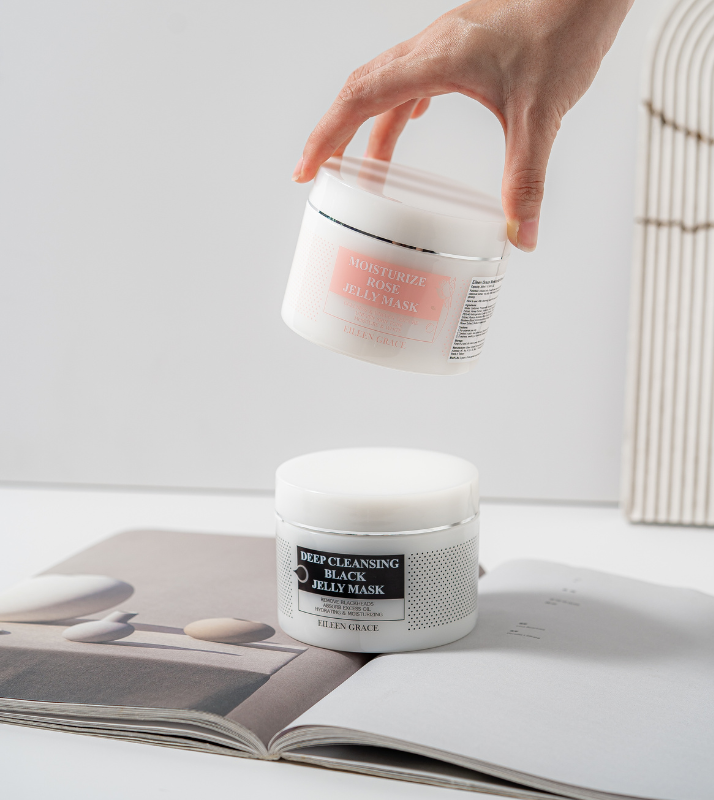
Eileen Grace makes both halves of that map. The Moisturize Rose Jelly Mask holds water against dry cheeks and is gentle enough for daily use, and the Deep Cleansing Jelly Mask clears the T-zone 2 to 3 times a week. They also come as a pair, which is what most people with combination skin end up needing. Still deciding where to start? Here is how the 2 compare.